
Mālama Hulē‘ia is a Hawaii nonprofit corporation formed in 2015. According to its Bylaws, the specific objectives and purposes of this corporation are to:
“advocate for, participate in and lead a community effort to eradicate red mangrove and other alien and invasive plant species from riparian areas along the Hulē‘ia estuary and river, to replant all areas cleared of mangrove with native or Polynesian-introduced vegetation, and to establish a stewardship program and organization that will sustain the restored Hulē‘ia watershed in ways consistent with traditional Hawaiian beliefs and practices in caring for and cultivating land and water, and such other goals as the board may deem appropriate.”
In its most recent strategic planning session, the Mālama Hulē‘ia Board of Directors has interpreted these corporation objectives and purposes with the following mission and vision statements:
Our Mission
Mālama Hulē‘ia advocates, educates, and leads community efforts to remove red mangrove along the Hule‘ia river, re- establishes native wetland ecosystems and creates an environmental stewardship program honoring Hawaiian values.
Our Vision
A free-flowing, healthy and productive Hulē‘ia ecosystem perpetuating community pride.
Our History
Mālama Hulē‘ia was spawned by two Kaua‘i community organizations that work in different ways with and on the water. The first is the Nawiliwili Bay Watershed Council, and the second is the Kaiola Canoe Club.
Nawiliwili Bay Watershed Council
The Nawiliwili Bay Watershed Council (NBWC) was formed in 1999 as a group of citizens united by a concern about the degradation of the watersheds feeding into the Nawiliwili Bay (including the Hulē‘ia, Pū‘ali, Papalinahoa and Nāwiliwili Streams). Part of the stimulus for formation of this group was the Hawai‘i Unified Watershed Assessment published in 1998, which classified the Nawiliwili Bay Watershed as “Category I – Watersheds in Need of Restoration: These watersheds do not currently meet, or face immanent threat of not meeting, clean water and other resource goals.” NBWC responded by assisting with a couple of grant-funded projects designed to raise public awareness about the problems of run off in the watershed. One the NBWC projects resulted in the educational website ‘Ainakumuwai: Ahupua’a of Nawiliwili Bay by Pat Cockett, which we often use as a source of historical information and pictures of our area. Another important contribution by members of the NBWC was in cooperating with the three phase Assessment and Protection Plan for the Nawiliwili Watershed, which was completed in 2004 and formed the basis of the Nawiliwili Watershed-Based Plan. This is the plan that enables use of US EPA Section 319 to clean up a watershed. (Links to the studies mentioned here are provided on our References page.)
In 2009 NBWC set for itself four priorities: 1. Restoration of Alekoko Fishpond. 2. Working with water rights advocacy groups to correct stream diversions. 3. Controlling nonpoint sources of water polution. 4. Restoration of kalo loi on kuleana lands.
While some of the spark the for the NBWC may have gone out with the passing of founding member Cheryl Lovell-Obatake, the core concerns of the group are still alive and well. Key contributing members of NBWC, including Don Heacock, Carl Berg, Adam Asquith, and Debbie Jackson are actively planning for resurgence of the group. Moreover, in different ways these same people have shaped Mālama Hulē‘ia. Mālama Hulē‘ia’s vision for a revitalized watershed, including restoration of the Alekoko Fishpond, is the same as that envisioned by NBWC. And Mālama Hulē‘ia’s goal of eradicating red mangrove and restoring riparian areas and wetlands damaged by the mangrove contributes directly to NBWC’s goal of protecting and improving the health of the Nawiliwili Bay Watershed.
Kaiola Canoe Club
The Kaiola Canoe Club has been and will continue to be the mother organization of Mālama Hulē‘ia. Although we are different corporations now, our formative years were as a project steering committee within the Kaiola Canoe Club. As active outrigger canoe paddlers, we felt the urgency to do something about the red mangrove invasion of the Hulē‘ia River and responded by forming Mālama Hulē‘ia. The following pages summarize our goals and initial efforts and reflect the affinity we feel for the Hulē‘ia River and surrounding area.
For the years 2013 through 2014, Kaiola Canoe Club received two one year grants from NOAA and the Hawai‘i Community Foundation to start the mangrove eradication at a demonstration site next to the Kaua‘i County Niumalu Beach Park. In addition to funding mangrove eradication and native plant restoration, the grants provide for building community support and partnerships for long term stewardship of the area. Mālama Hulē‘ia is following suggestions from the community to make the demonstration site into a place for environmental and cultural education for local youth.
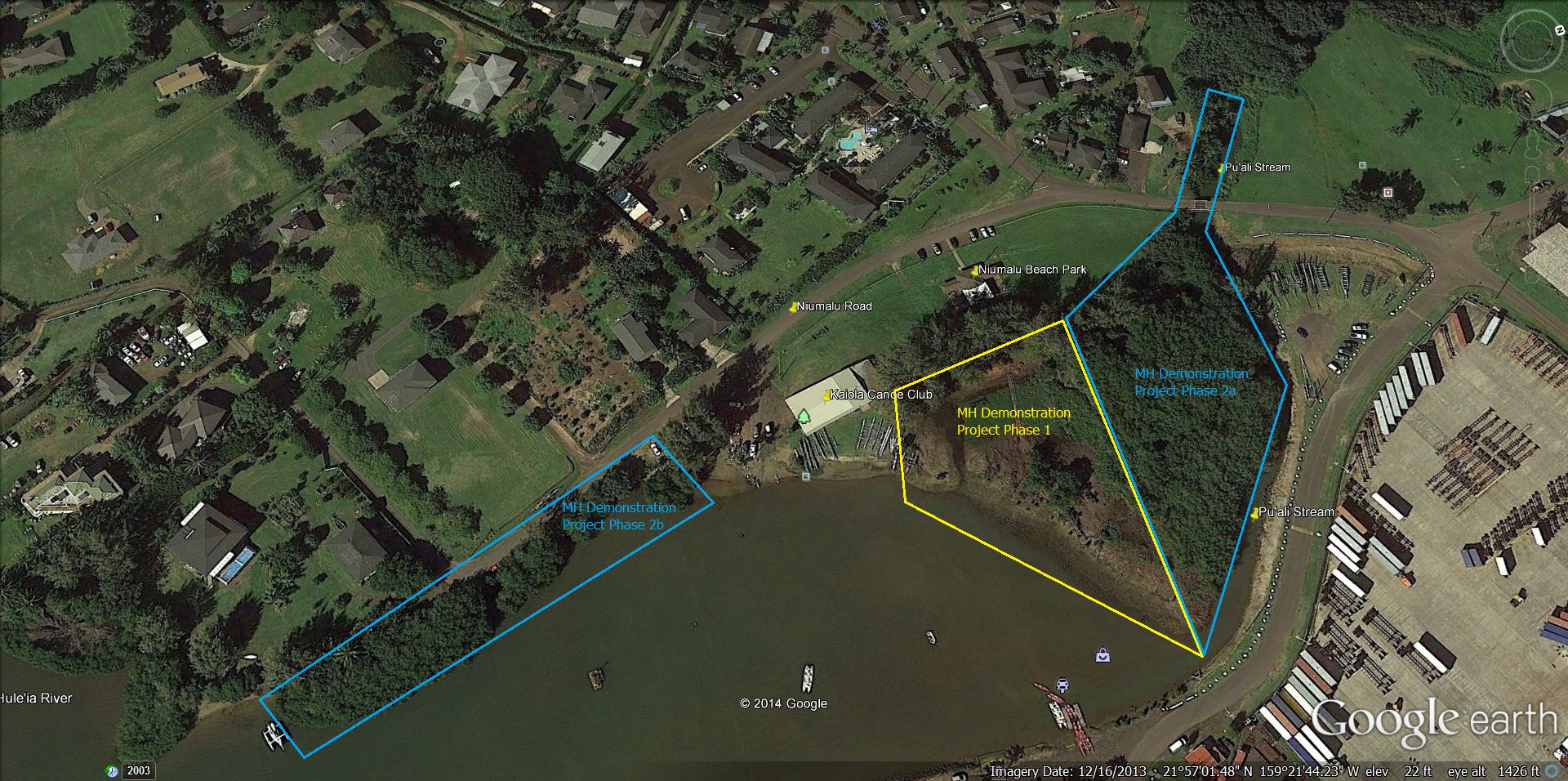
(Google Earth image)
Beyond the two years grant-funded project, the mission of Mālama Hulē‘ia is to clear red mangrove from the entire Hulē‘ia River valley and estuary, and restore all cleared areas to native vegetation. Ultimately, the areas to be restored should include the culturally precious ‘Alekoko (or Menehune) fishpond. Our vision is that the entire ‘Ainakumuwai (Watershed) Hulē‘ia will one day be revitalized and as productive as it once was.
 malamahuleia.org